Should Optimus Prime Be Insured? Ask China’s ‘Bottom Journals’
The papers look like they belong in top-tier academic journals: abstracts up front, references at the back, arguments neatly laid out in between. The language is precise. The tone is professional.
The content is nonsense.
One paper asks whether Optimus Prime should be insured for vehicle damage or personal injury. Another offers a typological study of grains in the archaeology of Stardew Valley, the hit farming video game. A third examines whether dogs understand themselves as having four feet or two hands and two feet.
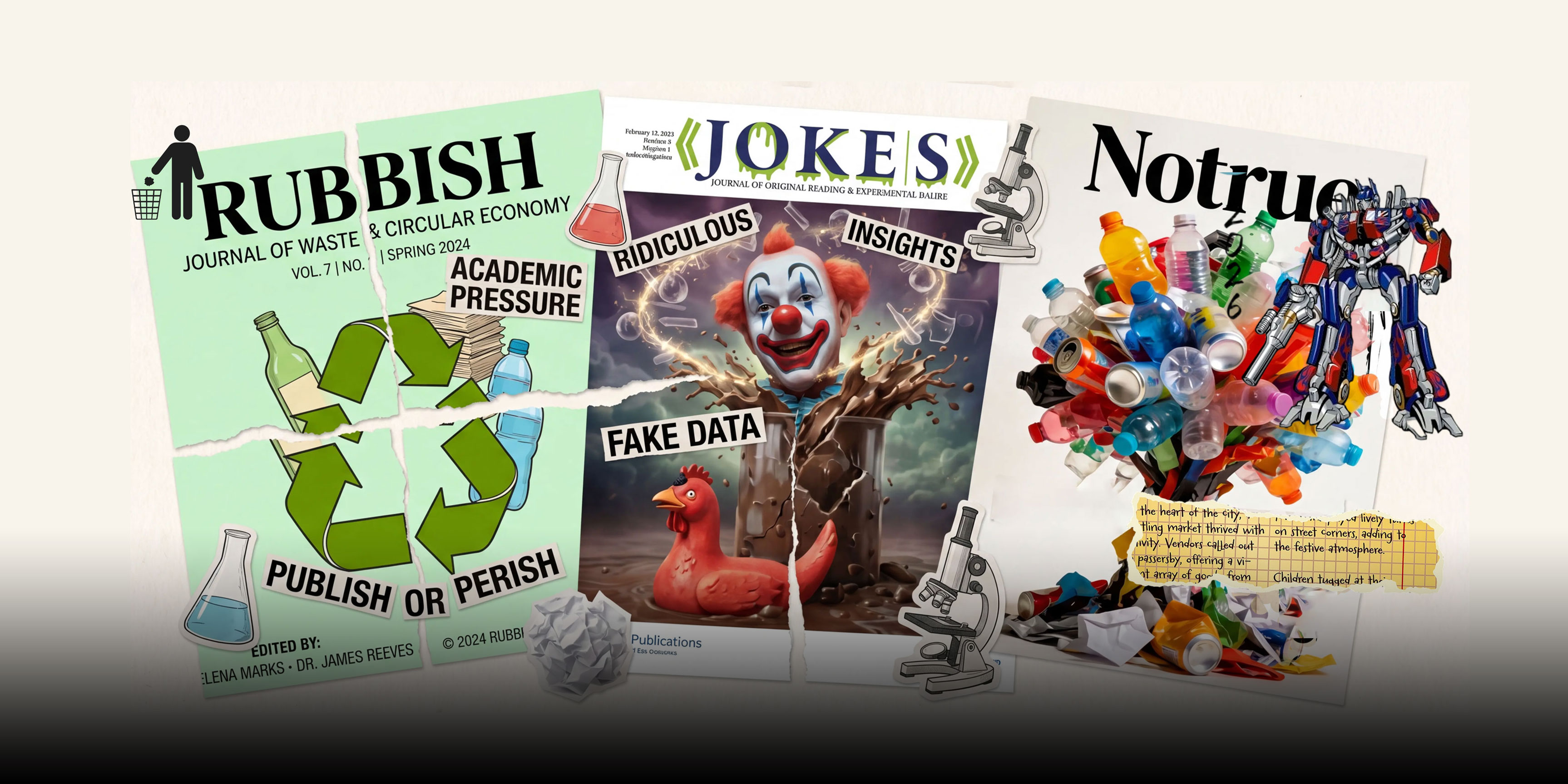
Together, they belong to a fast-growing wave of Chinese parody accounts known as “bottom journals,” a tongue-in-cheek counterpart to the country’s elite “top journals.” Across these outlets, failed experiments, pop culture references, and everyday frustrations are recast as formal research papers.
Since February, the format has spread quickly across Chinese social media, drawing contributions from undergraduates, postdocs, and professors alike. For many, the journals offer a place to turn revision fatigue, failed results, and academic stress into something lighter.
Their rise comes amid ongoing debate over publication pressure and evaluation systems that remain driven by output. Some accounts were later restricted or suspended on social media, even as state media cast the trend as a recognizable expression of fatigue among young researchers.
Paper trail
Wang knew the feeling well. In November 2024 she was a 20-year-old philosophy junior at a university in southwestern China, reworking a paper for the sixth time when she snapped.
From her classroom, she posted on social media: “I’m going crazy revising my paper. I really want to start a journal called Rubbish and publish it there.” Then she slammed her laptop shut.
Wang went straight back to revising after hitting publish. But the post struck a nerve, drawing more than 10,000 likes on Xiaohongshu, known internationally as RedNote.
“At first it didn’t seem that viral, but then the responses just kept growing,” said Wang, who asked to be identified only by her surname for privacy reasons. “I can’t even name one comment that stood out. Everyone seemed to be hating the same thing at the same time.”
For more than two years, it remained a joke.
Then, in February, Li Shiyu came across a post on Douyin, China’s version of TikTok, in which a researcher complained that a failed western blot result — a lab technique used to visualize proteins — “looked like a panda.” One comment read: “This should be submitted to Rubbish.”
Li, a 23-year-old biomedical engineering graduate student in Beijing, took the suggestion more seriously than it was meant. During the Spring Festival holiday, he used AI tools to design a green, recycling-themed cover, renamed his Xiaohongshu account Rubbish, and began soliciting submissions.
The Douyin user agreed to “lend” him the image. Within hours, Li had published the first Rubbish paper, drawing on his own lab experience and polishing the text.
By the next morning, notifications were pouring in. Each refresh brought more likes, comments, and submissions. Within 10 days, Rubbish had attracted more than 30,000 followers and, in less than two months, published more than 200 papers.
As the account grew, more parody journals began appearing online. Some borrowed from the titles of elite publications — Call, Nothing, Silence — while others opted for originals like JOKES, short for Journal of Original Kidding & Experimental Satire.
Li’s inbox filled with submission requests and offers to join as reviewers. “We started seeing sub-journals pop up across all kinds of fields — neuroscience, philosophy, geography, management,” Li said. “People even helped set up an official WeChat account and a website.”
On the day Rubbish went viral, a 25-year-old master’s student in central China, Chen Tong, joined in. Struggling through his own paper revisions, he founded Rubbish Communications, which would become one of the largest sub-journals, and later began helping Li manage the growing operation.
Soon the reviewer pool had grown to more than 30 volunteers, from graduate students to researchers across disciplines. “We even received applications from senior professors at top universities,” Chen said. “Their CVs were full of journals I could never hope to publish in my whole life, yet they wanted to join us.”
By April, the joke had outgrown Rubbish. According to Web of Nothing, an index of bottom journals, at least 373 had emerged, publishing more than 629 papers.
Some documented failed experiments, like “My elimination function looks like Mount Fuji.” Others treated everyday life as research material, as in “Late-Night Takeout Answers: A Cross-Brand Comparison of Hamburgers.”
And some gave themselves over entirely to absurdity, including “A Study on Cross-Time Literary Marriage: Argumentation on the Feasibility of the Lin Daiyu-Voldemort Pairing from the Perspective of Astronomy, Calendar, and Spatial Field.”
Side effects
Zhang, a 22-year-old first-year graduate student from the eastern Fujian province who asked to be identified only by his surname, said the appeal of the bottom journals lay in their tension: serious academic language applied to something obviously unserious. The result, he said, was a space between academic writing and public expression.
“It’s entertaining,” he said, “but also subtly challenges the authority of academic expression.”
During the Spring Festival holiday, Zhang watched the usual family grilling unfold around him: marriage, housing, salaries, partners. The result was his own bottom paper published in Silence, a parody of Science, titled “Quantum Inhibitory Effects of Relatives’ Soul-Questioning on Brain Defense Systems During Chinese New Year.”
Drawing on his neuroscience background, Zhang wrote that his subjects developed “selective deafness” in the prefrontal cortex when faced with familiar holiday questions. The hippocampus, meanwhile, retrieved escape strategies such as “Where is the bathroom?” He even coined a fictional neurotransmitter: “Defensin-CNY.”
“Most of it was made up,” Zhang said. “But the terms are metaphors for people’s real psychological state.”
Many contributors described bottom journals as a way to write through publication pressure, supervisor criticism, and uncertainty about academic careers, even as official efforts in recent years have tried to loosen the hold of paper counts and other metrics on evaluation.
Some of the most widely shared papers made that pressure explicit. One treated the “principal investigator,” the lead researcher for a grant project, as “one of the great unsolved mysteries of modern science,” complete with a fictional affiliation to the “Department of Hair Loss and Alchemy.” Another traced the shift in mindset from “I Can Publish in Top Journals” to “I Just Want to Graduate.”
Breti Wu, a 21-year-old archaeology undergraduate in the northwestern Shaanxi province, said a rejection from Rubbish for being “too academic” taught him to write more engagingly. He returned with a typological study of “artifacts” in Stardew Valley, analyzing 42 items “unearthed” from the game. The parody account Journal of Un-Archaeology accepted it within hours.
“It was my first published paper,” he announced on social media. Real journals had rejected him, but this one found readers. To his surprise, many of them were gamers rather than archaeology enthusiasts.
“Maybe that’s a good thing,” Wu said. “It reminds me of public archaeology, which helps people understand what archaeology actually is.” Before he explained it, he added, some of his family had assumed archaeology simply meant digging up tombs.
Starting early March, most major bottom journals on Xiaohongshu, including Rubbish, were restricted or suspended for “violating platform rules.” Rubbish also had accounts on Chinese social media platforms Douyin, Zhihu, Bilibili, and Weibo, but none had attracted comparable follower counts.
Days later, the team behind Rubbish held its first online meeting to draw clearer boundaries around the project: no illegal content, no incitement of gender conflict, no profit-making, and no full reliance on AI. Above all, it was “for entertainment only.”
Rubbish continued publishing mainly through WeChat and its independent website, but the momentum soon faded. Submissions slowed, article views fell from the tens of thousands to the low hundreds, and many journals launched at the height of the craze stopped updating altogether.
Yet in April, the trend received a different kind of attention. In a commentary, the state-run Science and Technology Daily, overseen by China’s Ministry of Science and Technology, said bottom journals reflected the fatigue, frustration, and anxiety of young researchers working in a system where “top journals” still carry outsized weight, despite years of reform.
It argued that the parody journals also pointed to a desire for diverse forms of work to be recognized and for “a more tolerant academic environment for failure.”
Li has since grown used to explaining how he created Rubbish, and to hearing others read broader meanings into it. He said he had not set out to speak for stressed researchers or make a larger point about academic pressure.
“At first, I didn’t have any particular purpose,” he said. “It was only after repeated media interviews that we began to see that side of it, and started to frame it in those terms.”
Wang is now approaching graduation. Unlike two years ago, she is no longer certain she wants to pursue an academic career. “There are so many external factors. I can’t illustrate them. But I do realize that passion alone does not guarantee a smooth path forward,” she said.
Looking back, Wang said the joke began as a philosophical question: why was everyone chasing “good,” and who got to decide what counted as good in the first place? “Later, I realized it wasn’t just an abstract question anymore. It was also about how hard publication can be, and how trapped people feel by evaluation systems.”
Rubbish, she added, also brought her back to her original motivation for research — the old self that “always wonders about the unknown and feels the genuine joy in every small discovery.”
Some of that feeling lingers on the website, where new submissions still arrive, though less often than before.
One recent paper asks: “Why Does Life Fall Asleep? On Making Bedtime Audiobooks More Coherent.” It traces the problem to the hippocampus clocking out early, sleep spindles standing guard at the door, and the prefrontal cortex meddling long past quitting time.
After all the mock rigor, the paper simply concludes: we fall asleep because we are tired.
Editor: Apurva.
(Header image: Visuals from Xiaohongshu and Weibo, reedited by Sixth Tone)